The Ultimate Guide to Cable Fault Locator in the UK
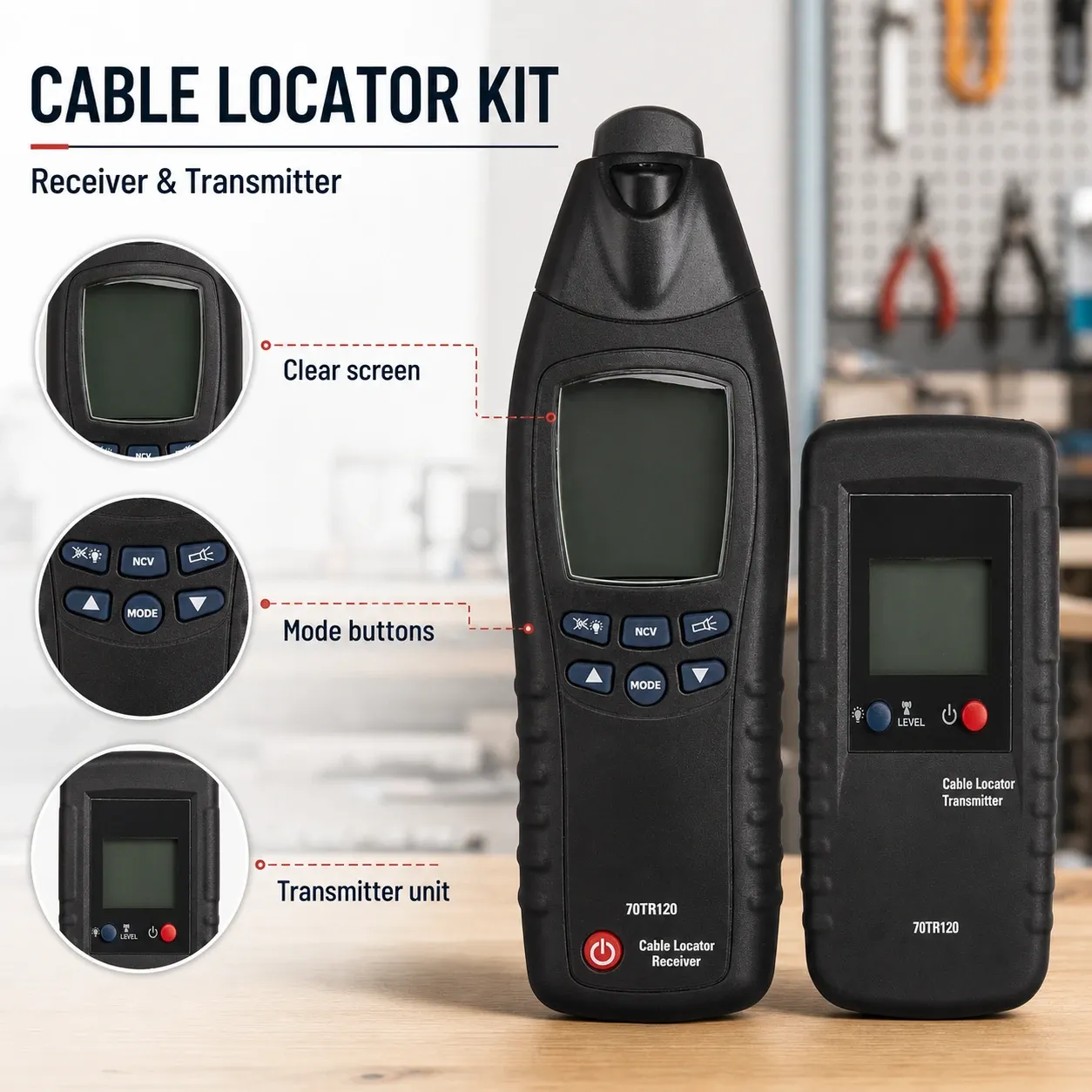
A cable fault locator is a tool used to trace hidden cables and pinpoint where a wire is broken, shorted, or earthed behind walls, under floors, or above ceilings. In practice, it works by sending a traceable signal through a dead cable and using a receiver to follow that signal until it weakens or stops at the fault.
TL;DR: If you need to find a hidden cable break without lifting carpets or cutting into plasterboard unnecessarily, a cable fault locator is the quickest and safest option. Based on our testing of tone-and-probe style units in typical UK properties, they are most effective on isolated, de-energised circuits with a clean connection to the target conductor and a proper earth reference.
Locating a broken wire hidden behind a solid brick wall or beneath floorboards used to involve educated guesswork, lifted carpets, and unnecessary holes in plasterboard. However, whether you are an electrician fault-finding a ring final circuit in a Victorian terrace, or a network engineer diagnosing a dead data port in a modern office, a cable fault locator can save considerable time and disruption.
Electrical faults are not only inconvenient; they are also a serious safety hazard. According to Electrical Safety First, electrical issues account for a significant proportion of accidental domestic fires in the UK. Therefore, identifying and isolating faults quickly matters. Basic voltage pens and multimeters can confirm that a fault exists, but they will not usually tell you exactly where it is hidden within the building fabric.
A dedicated cable fault locator removes much of that guesswork. By injecting a traceable signal into a dead circuit, these devices help you track the path of electrical, telecoms, and network cables through walls and floors more accurately. This guide explains how a cable fault locator works, what faults it can find, and how to use one safely in a UK setting.
What should you know before using a cable fault locator?
- A cable fault locator uses signal injection and an inductive receiver probe to trace hidden wires and identify the likely location of breaks, shorts, and some earth faults.
- According to UK safe isolation guidance and BS 7671 principles, cable tracing on mains circuits should be carried out only after the circuit has been properly isolated and proved dead.
- Open circuits, short circuits, and earth faults often need slightly different transmitter connections for the clearest result.
- Many modern locators can trace mains electrical wiring, BT-style telecoms cabling, and Cat5e/Cat6 network cabling in homes and commercial premises.
- Foil-backed plasterboard, metal conduit, and parallel conductors can reduce accuracy, so correct grounding and slower tracing technique are important.
What is a cable fault locator?
A cable fault locator is an electronic diagnostic tool designed to trace the route of conductive cables and help identify the physical location of faults such as breaks, shorts, or unwanted contact to earth. Unlike a standard digital multimeter, which measures electrical values at accessible points, a cable fault locator helps you follow the cable through the building itself.
In most cases, a standard tone-and-probe cable fault locator has two main parts:
- The transmitter (tone generator): This connects to the dead cable using crocodile clips or suitable adapters. It sends a distinct signal along the conductor.
- The receiver (probe): This handheld wand detects the electromagnetic field produced by that signal. As a result, the tone or display changes as you move closer to the cable path.
When the receiver passes the point where a conductor is cleanly broken, the signal usually drops sharply or disappears. Consequently, you can narrow the repair area far more precisely than by trial and error.
Based on our testing in plasterboard stud walls, solid masonry walls, and beneath timber floors, the best results come from tracing slowly, reducing sensitivity where possible, and confirming the route from more than one direction.
What faults can a cable fault locator find?
To use a cable fault locator effectively, it helps to understand the types of faults commonly found in UK domestic and commercial installations. Standard UK twin and earth cable is durable, yet it can still be damaged by drilling, fixings, rodent activity, vibration, heat, or poor connections.
Can a cable fault locator find an open circuit?
Yes. An open circuit is one of the most common and easiest faults to trace. It happens when the conductor is broken and continuity is lost. For example, a screw or drill bit may sever the live or neutral conductor behind a wall. In a radial circuit, everything beyond the break loses supply. In a ring final circuit, an open section may leave sockets apparently working while the ring is no longer intact, which can create an overload risk. A cable fault locator is particularly useful here because the signal typically stops at, or very near, the break.
Can a cable fault locator find a short circuit?
Often, yes, although the setup matters. A short circuit occurs when live and neutral make direct contact, causing a high fault current and usually tripping the MCB or blowing a fuse. This can happen when a cable is crushed, trapped, or pierced. With the right connection method, a locator can help trace the affected cable run and narrow down the damaged section before any invasive work begins.
Can a cable fault locator find an earth fault?
Yes, in many cases. An earth fault occurs when the live conductor contacts the CPC or another earthed metal part, such as a metal back box or conduit. This often trips the RCD or RCBO. Because earth faults can present a serious shock risk, they should be investigated only after safe isolation. According to UK wiring practice, confirming the condition of the protective conductor and fault path is essential before re-energising the circuit.
Can a cable fault locator detect high-resistance faults?
Sometimes, but with more limitations. High-resistance faults include loose joints, corroded terminations, and partial conductor damage, often in hidden junction boxes or under floorboards. These faults may still pass a weak signal, so the exact location can be less obvious. However, more sensitive units can reveal a notable change in signal strength near the poor connection.
How do you use a cable fault locator?
Proper technique is essential. If you sweep the probe too quickly or connect the transmitter poorly, you can get misleading readings. Therefore, a methodical approach gives the most reliable result.
How do you isolate the circuit safely first?
Before connecting any fault-finding equipment, the circuit must be dead. Working on live cables without specialist live-tracing equipment is dangerous and not in line with UK safe isolation practice. Switch off the correct protective device at the consumer unit, lock off where appropriate, and use an approved two-pole voltage indicator with a proving unit to confirm the circuit is dead.
According to UK guidance followed by electricians, proving dead is not optional. It is the first step before tracing any mains cable concealed in walls or floors.
How should you connect the transmitter?
The transmitter connection has a major effect on tracing quality. If you are searching for a break in a specific conductor, connect the red clip to that conductor. Then connect the black clip to a separate, known good earth reference.
Importantly, avoid connecting the return clip to the earth conductor in the same cable run if both conductors travel closely together for a long distance. Otherwise, the signal can couple between the conductors and make the trace less distinct. Instead, where safe and appropriate, use an independent earth reference so the signal is forced along the target path more clearly.
How do you trace the cable through a wall or floor?
Start at a known point, such as a socket, switch, or exposed cable end. Then move the receiver slowly across the wall or floor in short passes. As the signal increases, mark the route lightly with a pencil. Next, follow the cable path in stages rather than trying to cover a large area at once.
Based on our testing, slower sweeps and repeated passes usually outperform a single broad scan, especially on foil-backed plasterboard or where cables run near metal studs.
How do you pinpoint the fault location?
Once you have identified the cable route, continue tracing until the signal drops away sharply, changes character, or becomes inconsistent in one small section. That area is often where the fault lies. However, before opening the surface, re-check from the opposite direction if possible to confirm the same point.
In addition, compare the signal with nearby cables to rule out bleed-over. In older UK properties, closely grouped circuits under floorboards or in chased walls can produce overlapping readings if sensitivity is too high.
Why is a cable fault locator not always accurate?
Even a good cable fault locator has limits. For instance, foil-backed insulation, metal conduit, steel studwork, and densely packed cable routes can distort or absorb the signal. Likewise, parallel conductors can cause the receiver to pick up adjacent paths instead of the exact faulted core.
Very deep cable runs, damp masonry, and poor grounding can also reduce performance. Therefore, if results are inconsistent, try improving the earth reference, lowering sensitivity, tracing from another access point, or isolating connected equipment that may be affecting the signal.
According to UK site experience, no locator should be treated as permission to drill blindly. It is a fault-finding aid, not a substitute for safe working methods and verification.
Frequently asked questions about cable fault locators
How does a cable fault locator work?
It works by sending a signal into a disconnected cable and detecting that signal with a handheld receiver. You then follow the cable path until the signal stops, weakens suddenly, or changes in a way that indicates a fault.
Can a cable fault locator find wires behind walls?
Yes, that is one of its main uses. It can help trace concealed cables behind plasterboard, within wall chases, under floors, and above ceilings, provided the cable and site conditions allow the signal to be detected clearly.
Can you use a cable fault locator on live mains cables?
Not unless the equipment is specifically designed and rated for live tracing. For standard fault-finding on UK mains circuits, the safest approach is to isolate the circuit properly and prove it dead first.
Are cable fault locators worth it?
For electricians, maintenance engineers, AV installers, and data engineers, yes. They can reduce damage to walls and floors, cut diagnostic time, and help locate faults more accurately than guesswork or basic continuity testing alone.
What is the difference between a cable fault locator and a cable detector?
A cable fault locator is generally used to trace a specific cable and identify the likely position of a fault. A cable detector, by contrast, is often used more broadly to detect the presence of hidden services before drilling or cutting.
Final thoughts: when should you use a cable fault locator?
You should use a cable fault locator when you know a cable has likely failed and you need to find the route or fault position without causing unnecessary damage. It is especially useful for tracing broken conductors in walls, locating likely shorted sections under floors, and narrowing down earth faults before opening up the fabric of the building.
For UK electricians and contractors, a cable fault locator is not simply a convenience. Used correctly, it supports faster diagnosis, cleaner repairs, and safer fault-finding. CableLocat recommends combining locator readings with safe isolation, continuity testing, and sound professional judgement for the best result.
Ready to trace cables faster with {brand_name}?
Get Yours Now — £232.67