Wire Tracer Fishing Explained: A UK Buyer's Guide
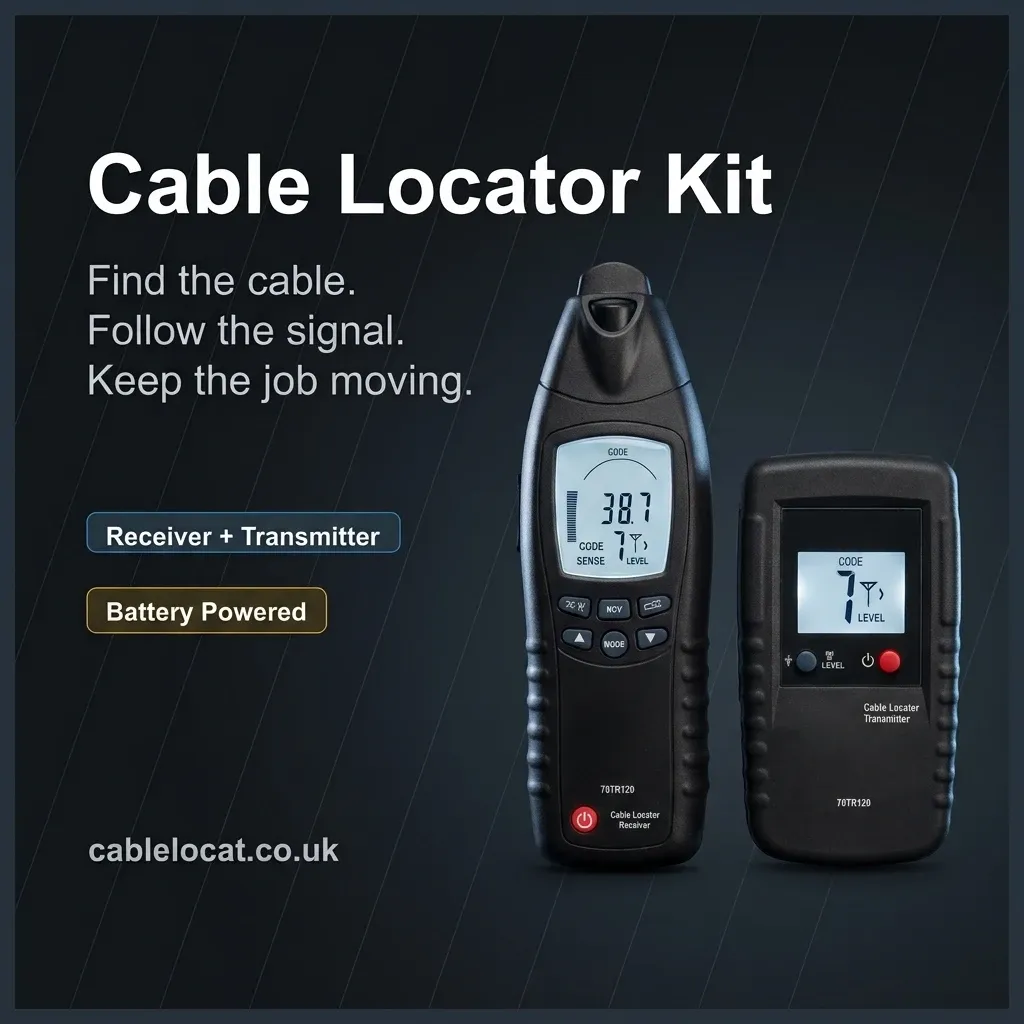
Fishing a wire through a wall or ceiling should be straightforward. In practice, it often turns into a slow job of guesswork, hidden obstructions and repeated test holes. That is where wire tracer fishing becomes useful. Instead of pulling blindly and hoping you have found the right route, a dependable cable finder helps you trace likely paths, identify live and dead runs, and work more efficiently before you start opening up plasterboard or lifting floors.
For UK electricians, maintenance teams, landlords and capable DIY users, the appeal is obvious: quicker fault-finding, less damage to finishes, and a simpler way to follow electrical, telecom and network cables through walls and floors. CableLocat is built around that everyday need. The brand’s main promise is clear: the dependable cable finder tool for everyday fault-finding. The aim is practical accuracy without the premium price tag or complex setup.
This guide explains what wire tracer fishing means in UK settings, how these tools work, who they are best for, what features matter when buying, and how to use one safely and effectively.
Key Takeaways
- Wire tracer fishing means using a transmitter and receiver to follow cable routes before or during pulling, fault-finding or identification work.
- It helps reduce unnecessary drilling, lifting and wall damage when tracing electrical, telecom and network cables.
- For UK users, safety matters: always follow safe isolation procedures and use tools suited to local installation practices.
- The best buyer choice depends on cable type, tracing depth, signal clarity, ease of setup and value for routine work.
- CableLocat’s approach suits everyday fault-finding: quick setup, practical accuracy and no overcomplicated learning curve.
What does wire tracer fishing mean?
In plain terms, wire tracer fishing is the process of locating or following the route of a cable so it can be identified, pulled through a cavity, separated from other runs or checked for continuity along its path. The word “fishing” is used because many jobs involve feeding rods, draw wires or pull lines through hidden spaces while trying to find the correct route at the other end.
A wire tracer adds intelligence to that process. Rather than relying only on visual access points or old drawings that may no longer match reality, you apply a signal to the cable with a transmitter and detect it with a handheld receiver. This helps confirm which cable you are dealing with and where it runs behind plasterboard, under floors or above suspended ceilings.
That makes it valuable for:
- finding the correct cable before pulling or disconnecting it
- locating hidden routes during refurbishments
- separating one run from multiple bundled cables
- checking likely cable direction before drilling or cutting
- supporting fault-finding where circuits have been altered over time
Why wire tracer fishing matters in UK properties
UK buildings create their own tracing challenges. Older housing stock often includes retrofitted circuits, mixed wiring eras, solid walls, timber floors and undocumented changes by previous owners or contractors. In commercial environments such as schools, surgeries, NHS facilities and office refurbishments, downtime and disruption carry a real cost.
The Office for National Statistics has reported that the median age of dwellings in England is several decades old, with much of the housing stock built before modern documentation standards became common. Older properties are far more likely to contain altered routes and unexpected junctions. Source: Office for National Statistics housing data.
That context matters because blind fishing wastes time. If you are tracing through lath-and-plaster partitions in a Victorian terrace or trying to identify network cabling above ceiling grids in a converted office block, speed depends on knowing where to look first.
A dependable wire tracer can help limit:
- exploratory cuts in finished walls
- wasted labour hours spent following the wrong run
- confusion between mains cables and low-voltage wiring
- avoidable disruption in occupied buildings
- mistakes when circuits have poor labelling
If you want broader background on tracing faults across different cable types in Britain, see The Ultimate Guide to Cable Fault Locator in the UK.
How a wire tracer works during fishing jobs
The basic transmitter-and-receiver method
Most wire tracers use two main parts:
- A transmitter, connected to the target cable or conductor pair
- A receiver, swept along surfaces or near cable routes to detect the applied signal
The transmitter injects an identifiable signal onto the line. The receiver then responds when it gets close enough to that signal path. By moving methodically across walls, floors or ceiling void access points, you can build up a route picture before attempting your pull.
Direct connection versus non-contact tracing
The strongest results usually come from direct connection where safe and appropriate. This gives a clearer signal path than simply scanning an area without establishing contact with the intended cable. Non-contact methods can still be useful for quick checks but tend to be less precise where there are multiple parallel runs.
Using tracing signals while feeding rods or draw wire
In practical fishing work, one common method is to attach your draw wire or fish tape through an access point while using the tracer to confirm nearby route direction. This does not physically pull the cable for you; it helps reduce uncertainty about whether you are moving towards the correct cavity zone or crossing into another run entirely.
The limits of any locator tool
No honest buyer’s guide should pretend every locator sees through everything flawlessly. Signal bleed can occur around tightly bundled cables. Depth affects readability. Metal trunking can alter detection behaviour. Dense masonry can reduce certainty compared with plasterboard stud walls. A good tool improves decision-making; it does not replace judgement on site.
Who should buy a wire tracer for fishing work?
Professional electricians
If you regularly carry out rewires, consumer unit changes, fault diagnosis or extension work, wire tracer fishing saves time across repeated tasks rather than on one dramatic job alone. It is especially useful when identifying existing runs before chasing walls or lifting floorboards.
Apprentices and improvers
A straightforward locator is helpful when learning how circuits are routed in real buildings rather than textbook examples. Ease of setup matters here because overcomplicated menus slow down site use.
h3>Landlords and maintenance teamsFor planned maintenance in rented properties, care homes, offices or retail units, reducing unnecessary damage is often just as important as finding the problem itself. A practical cable finder supports faster inspections between tenancies or during reactive call-outs.
DIY users with sensible boundaries
A competent DIY user may use a wire tracer for low-risk identification tasks such as following telecom cabling or checking likely routes before renovation work. That said, mains electrical systems require proper safety procedures. If there is any uncertainty about isolation or circuit condition, use a qualified electrician.
h3>Network and telecom installers>For structured cabling work where multiple similar lines terminate near each other, identifying the correct route quickly prevents wasted patching time. If that is your main use case, Network Cable Tracer Explained: A UK Buyer's Guide gives more focused advice.
Tracing convenience must never override safe working practice. In UK electrical work, buyers should look beyond pure functionality and consider whether their process aligns with recognised safe isolation principles and suitable test equipment guidance such as GS38 where applicable.
BS 7671 does not tell you which retail wire tracer to buy, but it frames expectations around competent installation practice and verification culture within UK electrical work. That makes product reliability important: poor readings encourage risky assumptions.
Before you trace
< / h3>
-
Identify what type of system you are working on:
mains electrical,
ELV,
telecom
or network cabling.
< / li>
-
Isolate circuits properly where required.
Lock off if appropriate
and prove dead with suitable approved procedures.
< / li>
-
Check your leads,
clips
and accessories before use.
Damaged test leads undermine both safety
and results.
< / li>
-
Do not assume older labels are accurate.
Trace first,
then verify again before disturbing conductors.
< / li>
Sensible limits for DIY users
There is nothing wrong with homeowners wanting better visibility before drilling into walls or planning renovation routes. The line should be drawn at exposed conductors, uncertain circuit conditions or consumer unit work beyond competence level. That belongs with a qualified electrician.
br /> ""Common situations where wire tracer fishing saves time"
" " ""Finding the correct drop between loft and ground floor"
" " ""On extensions and rewires, you may know roughly where a vertical run should be but not its exact position inside boxed-in sections or stud partitions." A tracer helps narrow down direction before rods go in."
" " ""Bundles beneath upstairs floors are common in older homes that have seen repeated alterations." Instead of disconnecting several ends just to discover which line serves which point, you can trace methodically."
" " ""Small commercial refits often inherit unlabeled data cabling." A simple locator speeds up cabinet-to-desk identification without unnecessary patch panel disruption."
" " ""Some users apply similar logic outdoors when following low-voltage runs linked with gates, outbuildings or comms lines." Ground conditions vary widely though, so choose tools intended for that environment if this will be frequent."
" "If your work frequently overlaps with general fault location rather than route finding alone,\nThe Ultimate Guide to Cable Fault Locator in the UK\nwill help place tracers within the wider range of diagnostic tools available in Britain.
CableLocat’s place in this category
CableLocat positions itself around day-to-day practicality rather than inflated promises. That suits buyers who need dependable results for regular fault-finding, not an expensive specialist system they only fully understand after reading three manuals.
The core proposition fits wire tracer fishing particularly well:
- No premium price tag: useful if you want capability without paying for niche extras you may never use.
- No complex setup: important when jobs move quickly between rooms, properties or service types.
- Trace electrical, telecom, and network cables through walls and floors quickly and accurately: exactly what many British users need during identification, routing and light investigative work.
This sort of positioning appeals both to tradespeople who want reliable support gear and buyers who need occasional use without compromising on basic performance standards. Trust comes from consistency: a tool that works predictably on everyday jobs earns its place faster than one packed with obscure features.
<\/section>Ready to make wire tracer fishing easier?
If you want quicker identification, less guesswork and fewer unnecessary holes during fault-finding, choose a tool designed for real-world jobs rather than showroom spec sheets. CableLocat focuses on dependable tracing across electrical, telecom and network cables through walls and floors — without premium pricing and without complicated setup.
Shop CableLocat’s cable finder tools today.
< / section >
Depth figures look impressive but rarely tell the whole story.
Signal clarity,
cable type,
site congestion
and wall construction usually matter more.
A slightly less ambitious specification that performs consistently may be far more useful.
< / p >
If several people may use the tool —
for example across maintenance staff,
apprentices
or small contractor teams —
clarity beats complexity.
Straightforward controls reduce training time
and operator error.
< / p >
Homes,
shops
and offices often combine mains wiring,
telephone cabling
and data infrastructure.
One flexible solution can make better buying sense if your properties vary.
< / p >
Tracing still involves contact points,
assumptions about conductors
and decisions based on readings.
Treating it casually creates avoidable risk.
Never let convenience outrun verification.
< / p >
Wire tracer fishing is used to locate,
identify
and follow hidden cables so they can be pulled,
separated,
tested
or worked around more efficiently.
It is especially useful behind walls,
under floors
and above ceilings where visual access is limited.Mistakes buyers often make when choosing a wire tracer
Buying purely on maximum advertised depth< / h3 >
Frequently Asked Questions
What is wire tracer fishing used for?
Can I use a wire tracer on network and telecom cables as well as electrical wiring?Network Cable Tracer Explained: A UK Buyer's Guide
Ready to trace cables faster with {brand_name}?
Get Yours Now — £232.67